
Vous voulez apprendre à attraper le grand la prochaine fois que vous vous dirigez vers votre lac ou votre rivière préférée? Ou se préparer pour essayer un nouveau spot de pêche pour la première fois? Ne partez pas jusqu'à ce que vous ayez atteint les dernières astuces et techniques de pêche de notre pêcheur professionnel.
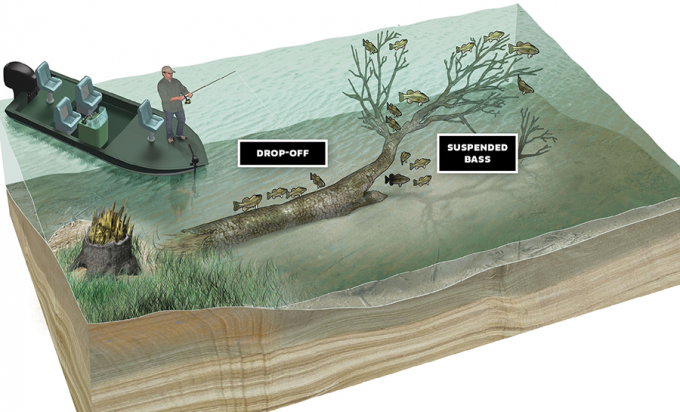
Ponds always starts on the outside perimeter and looks for the fullest, bushiest branches. The ones with lots of smaller branches and twigs attract suspending fish like isolated brush piles. From there, he’ll move progressively farther into the tree’s structure. Ponds focuses on the points where a main branch splits off from the trunk. This creates a Y space that fish will back into.
Lastly, Ponds will work the main trunk section. If one side of a laydown has a deeper drop-off, he’ll spend more time casting to it, as fish will utilize the depth change as a holding spot. From there they can move up to feed and then drop into safer depths.
When you follow a creek channel back into a spawning area scattered with brush and small trees, he scans the cover for signs of channel turns where bass will gather. Anglers can discern these sweet spots by looking at the different types of wood.
Brush may be jumbled throughout most areas, but hardwoods will point to the key directional changes in a creek channel’s course. Hardwoods grow on the inside edges of creek channels and signify target zones with high concentrations of bass.
So many trees, so little time—that’s the common problem for anglers contemplating an expanse of main-lake standing timber. A few strategies for identifying the more productive areas. First, target the trees with the most structural features. In a cluster of trees, the ones with intact branches will offer fish more cover and ambush points. Also, look for obvious gaps running through a stand of timber. This is usually a creek, drain, or slough, which acts as a funnel for bass.